
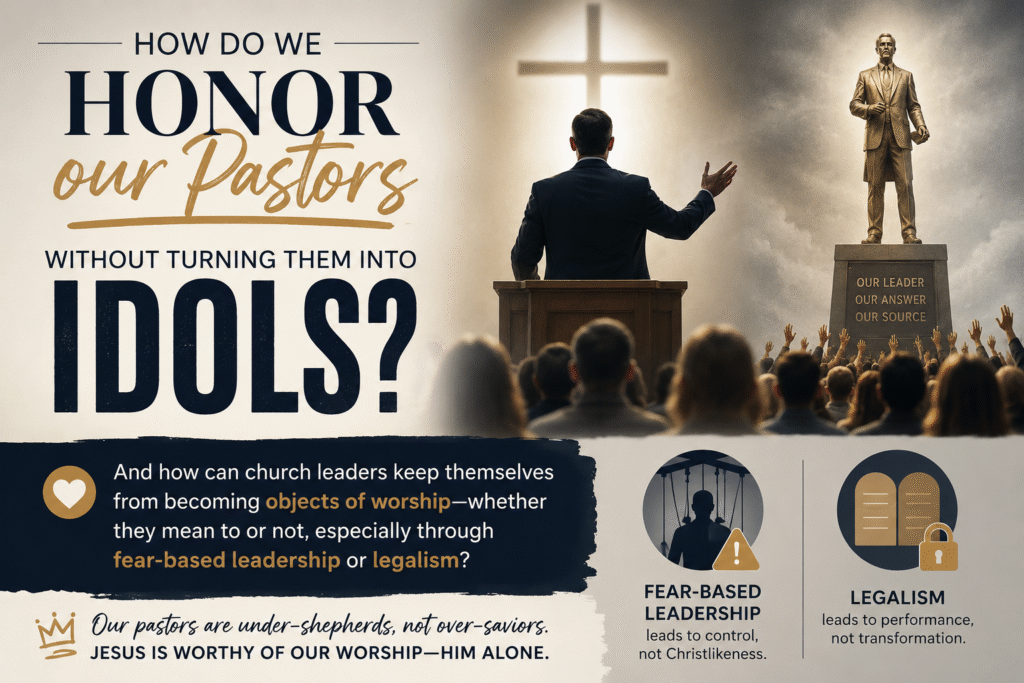
Introduction: The Temptation of the Golden Calf
When we hear the word idolatry, most of us probably picture something obvious—people bowing before statues or worshipping a golden calf. We rarely imagine idolatry happening in a church while someone is preaching from the Bible.
Yet it can.
Paul warned the Corinthian church about their willingness to embrace impressive “super-apostles” (2 Corinthians 11). They were drawn to personalities who appeared powerful, gifted and spiritually impressive. That temptation has not disappeared.
We live in a celebrity-driven culture, and churches are not immune to it. Without necessarily intending to, we can begin treating pastors like Christian celebrities, CEOs, spiritual heroes or even the person standing between us and God.
And sometimes leaders can become comfortable with that position.
That is dangerous for everyone involved.
Pastors are a gift to the Church, but they are not the Head of the Church. They are shepherds, teachers and servants. Jesus alone is the Head.
So how do we honour spiritual leadership without turning honour into worship? And how can pastors lead faithfully without allowing themselves to become the centre of people’s spiritual lives?
For the Congregation: Following Without Worshipping
There is nothing wrong with loving your pastor. There is nothing wrong with appreciating their preaching, respecting their wisdom or thanking God for their ministry.
Scripture actually tells us to honour faithful leaders.
But honour and idolatry are not the same thing.
One of the questions we should occasionally ask ourselves is: What exactly am I following?
Am I listening because my pastor faithfully teaches Scripture, or have I become attached to the personality?
Maybe they are charismatic. Maybe they communicate exceptionally well. Maybe their church is growing. Maybe their ministry looks successful.
None of those things necessarily mean something is wrong. The danger comes when our confidence in Christ slowly becomes tangled up with our confidence in a particular person.
Here is an uncomfortable test.
If your pastor fell tomorrow, would your faith fall with him?
If a pastor’s moral failure, theological error or departure from ministry would destroy our relationship with God, we may have built part of our foundation on the wrong person.
Paul wrote:
“For no one can lay any foundation other than the one already laid, which is Jesus Christ.”
— 1 Corinthians 3:11
Pastors can disappoint us. Jesus remains our foundation.
That is why discernment matters.
Acts 17:11 describes the Bereans receiving Paul’s teaching eagerly while still examining the Scriptures to see whether what he taught was true.
Think about that. They were checking Paul.
If Paul’s teaching could be examined against Scripture, surely our pastor’s teaching can be examined too.
Testing teaching against Scripture isn’t dishonour. Done with humility and sincerity, it is part of Christian maturity.
When Guidance Becomes Dependency
There is another danger that can develop gradually:
“I can’t make a decision unless my pastor approves it.”
Seeking pastoral counsel can be incredibly wise. We need people who will challenge us, pray with us and sometimes tell us what we don’t want to hear.
But counsel is different from surrendering our conscience.
A pastor should help people mature in their relationship with God, not become the person through whom every decision must pass.
Ephesians 4 describes pastors and teachers as gifts given to equip the saints and bring believers toward maturity.
Healthy ministry should therefore produce increasingly mature Christians—not adults who remain spiritually dependent upon one leader for every decision.
Your pastor can counsel you.
Your pastor can warn you.
Your pastor can teach you Scripture.
Your pastor can pray with you.
But your pastor cannot replace your own relationship with God.
Pray for Your Pastor, Not to Your Pastor
Sometimes our conversations about pastors reveal how much space they occupy in our minds.
We discuss their sermons, quote their sayings, defend their decisions and sometimes argue about their ministries.
But how often do we simply pray for them?
Pray for your pastor’s marriage and family. Pray for wisdom. Pray for protection from pride. Pray for courage when difficult decisions have to be made. Pray that private character remains stronger than public gifting.
And pray that they never begin believing the praise they receive belongs to them.
The best way to honour a pastor isn’t to pretend they are superhuman.
It is to remember that they are human and therefore need grace, prayer and accountability just like everyone else.
For the Pastor: Lead Without Becoming the Centre
This conversation cannot only be directed toward congregations.
Leaders have responsibilities too.
Most pastors probably don’t enter ministry thinking, I want people to worship me.
It usually happens much more subtly.
People begin praising your preaching. Attendance grows. People seek your opinion. Your decisions carry greater weight. Testimonies emerge from the ministry.
And somewhere along the way, it becomes possible to confuse what God is doing through you with what you are doing for God.
That is why John the Baptist’s words remain such an important prayer for anyone in ministry:
“He must increase, but I must decrease.”
— John 3:30
A useful question after preaching might therefore be:
Did I help people see Jesus more clearly, or did I mainly help them admire me?
There is nothing wrong with preaching well. Excellence isn’t pride.
But there is a difference between using our gifts well and needing people to be impressed by them.
Sometimes leaders need to examine their own sermons, decisions and church culture and ask:
Where am I pointing people toward Christ, and where might I accidentally be drawing them toward myself?
When Fear Starts Leading the Church
Control does not always begin with arrogance.
Sometimes it begins with fear.
A pastor becomes afraid that people will leave.
Afraid the ministry will shrink.
Afraid someone will make the wrong decision.
Afraid of losing authority.
Afraid that questioning leadership will create division.
And fear can slowly disguise itself as spiritual authority.
Statements begin appearing such as:
“If you question me, you’re questioning God’s authority.”
Or:
“You need my blessing before you do that.”
Or:
“Touch not God’s anointed.”
Or even threats that disagreement, leaving the church or failing to meet certain expectations will bring God’s judgement.
That isn’t healthy shepherding.
Paul reminds Timothy that God has not given us a spirit of fear (2 Timothy 1:7). Leadership driven primarily by fear will eventually produce fear in the people being led.
A shepherd leads.
A shepherd warns.
A shepherd sometimes corrects firmly.
But a shepherd does not need frightened sheep in order to maintain authority.
If people are afraid that leaving your church means leaving God’s protection, something has gone badly wrong.
People should remain because they believe God has planted them there—not because they are terrified of what will happen if they leave.
Legalism and the Pressure to Perform
There is another subtle way pastors can become too central: when pleasing the leader slowly becomes part of pleasing God.
The church has a vision.
There are programmes to run.
Volunteers are needed.
Attendance matters.
Giving matters.
Commitment matters.
None of those things are automatically wrong. Ministry requires commitment.
But something changes when people begin serving primarily because they are afraid of disappointing the pastor.
Eventually the question becomes:
“What will Pastor think?”
instead of:
“What is Christ asking of me?”
That is where healthy commitment can begin turning into legalism.
Pastors must be careful not to measure people’s spirituality simply by how useful they are to the ministry.
Someone’s value is not determined by how many services they attend, how many departments they serve in or how well they support the leader’s vision.
People do not exist to keep the church machine running.
The Church exists for Christ.
Grace should therefore shape not only what we preach about salvation but also how we lead people after salvation.
Practical Safeguards
Both pastors and congregations can help prevent unhealthy spiritual dependency.
Pastors need genuine accountability. Not simply people who agree with them or people whose employment depends upon keeping them happy. Every leader need people who can lovingly say, “No,” “You’re wrong,” or “You need to reconsider this.”
Allow pastors to be human. They have hobbies. They get tired. They make mistakes. They need holidays. They sometimes misunderstand situations. Removing unnecessary mystique around leadership protects both pastor and congregation.
Leaders should remember the word “we.” The Church isn’t one person’s ministry with everyone else helping. We belong to Christ together.
And finally, rest matters.
Exhausted leaders can become fearful leaders. When someone believes everything depends upon them, rest begins to feel irresponsible. But Sabbath reminds both pastor and congregation of something deeply humbling:
God’s Kingdom continues while we sleep.
We are needed, but none of us is indispensable.
The True Object of Worship
Ephesians 4 describes pastors as gifts Christ gives to His Church.
And gifts should be appreciated.
We can honour faithful pastors. Love them. Encourage them. Support them. Pray for them. Learn from them.
But we don’t worship the gift.
We worship the Giver.
For the congregation, perhaps the challenge is this:
Love your pastor. Honour faithful leadership. Receive correction when it is biblical. Follow their example as they follow Christ.
But never make them your foundation.
And for pastors, perhaps the prayer should remain the prayer of John the Baptist:
“He must increase, but I must decrease.”
May our ministries become fingers pointing away from ourselves and toward the Lamb of God.
Because ultimately, the best pastor isn’t the one who makes people unable to function without them.
The best pastor equips people to become completely dependent upon Jesus.
Questions for Discussion
- Have you ever put a pastor or Christian leader on a pedestal and later been disappointed? What did that experience teach you about the difference between trusting people and trusting Christ?
- For those in leadership: when was the last time you openly admitted that you were wrong? Does your church culture give leaders room to acknowledge mistakes?
- Have you ever heard phrases such as “touch not God’s anointed” used to shut down sincere questions or legitimate concerns? What effect did that have?
- Does your church culture encourage people to ask, “What would Jesus have me do?” or are people more concerned with “What will the pastor think?”
- Finally, whether leader or congregation member: If Jesus becomes greater and we become smaller, what would actually need to change in the way we do church?